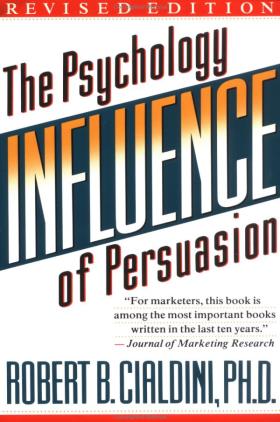
 Takeaway: Recognizing and reflecting on the fixed action patterns we exhibit under key behavioral triggers can help us safeguard ourselves against influencers. Recognizing the inherent power of persuasive appeals and fundamental drivers of human actions can help us better influence our environment for the collective good. Reciprocity, consistency, and social proof are powerful triggers that elicit unfamiliar and often surprising actions from people.
Rough notes:
- Fixed Action Patterns: humans react to certain cues almost instinctively. Canny marketers and people who wield influence tap into this fixed action pattern by identifying the specific cues that elicit reactions and exploiting them to seek help / favor from them
- Like the natural world (turkey, robin) where certain specific cues elicit default reactions;
- People in these situations act first and then think later, often binding themselves to a commitment that they would then need to complete; this, combined with the feeling of completeness or preference for taking things to its logical end make humans susceptible to external cues more than they realize
- “Compliance” is a critical skill that lets you influence or persuade others into submission
- The increasing complexity of the world dictates a sort of automatic reaction based on specific mental models that people unconsciously start exhibiting;
- To escape the “clueless middle” of the Macleod’s company hierarchy, sociopaths who end up climbing to the C-suite, exploit these mental models or instinctive reactions to a) sell more, b) influence people around, c) get more from juniors or people around, and d) influence leadership and get ahead
- Our ability to train ourselves in recognizing these cues in the people we interact with can go a long way towards ensuring you get what you want from them
- 6 types of persuasive appeals carry influence:
- Reciprocation: strategically offering help and support to induce feeling of reciprocation; this is powerful in many ways – creating leverage through small helpful acts can help generate an ecosystem of people who are willing to reciprocate with help on bigger things; “web of indebtedness” is a powerful tool and one that has been the backbone of the “gift” based economy; thinking of gifts as community building tools can enable you to create a community of people willing to help you with your pursuits in small / big ways and can go a long way towards ensuring your success personally and professionally
- Part of reciprocity also is the second level of compliance; people concede to someone who has already conceded to you in this feeling of reciprocity; hostage negotiators exploit this when they appear to be conceding to the kidnapper and expecting to get some concession for him/her in return
- Leveraging the idea of reciprocity is the concept of “givers and takers”. It is this powerful ecosystem and positive feedback loop that is created when you help someone in even the smallest possible ways
- Consistency: exploiting people’s preference for consistency by asking for small favor first and then asking for a bigger help later; people automatically fall into the trap of being consistent even when it’s not sensible since external social pressure advocates for consistency in how you present yourself; if you have committed publicly to something (as an identity, as a personality, as a trait), you are more likely to follow through on the ask/favor/influence yielding behavior to maintain a sense of consistency
- Freeing yourself from this subconscious bias requires a deep trust in your internal signals when this feeling of consistency clashes with your rational thought process; taking a step back and considering your values and reasons can help you ward off the influencers
- Social Proof: if you act like you are not sure, those around you like to influence you; gaining that social proof becomes important for people
- Werther Effect highlights the dangers of bringing people to identify themselves with a trait or behavior that then becomes difficult to dissociate themselves with
- If in an accident, do not wait for someone else to act; everyone around you is looking for cues and any delay or hesitation on your part will be catastrophic
- The concept of social proof is most powerful in ambiguous situations; when you don’t know what to believe in and how to behave, you look externally for cues and let others influence you; mob behavior is predicated on this one philosophy; in times of distress or radical turmoil people end up doing crazy things in order to continue identifying themselves with a particular group or identity
- Don’t stay silent when you see companies exploiting this in their commercials or outreach programs; being civic minded is extremely important for a functioning civil society
- Liking: you can be influenced if someone you care about asks you to do something; compliance professionals use the pyramid technique to influence a purchase or a decision
- The Halo effect has a known tendency to influence people
- The disproportionate effect of loss versus the possibility of gaining something makes people amenable to influencers
- Dealing with the halo effect requires dealing with the effect itself as opposed to the source behind it; recognizing when you are being influenced through external / artificial likeability can help you prevent being misled
- Authority: uniforms, degrees, positions are big indicators of influence; especially in uncertain situations; civilization functions by respecting authority; we are led to believe that schools are the authority on education and let that guide the better part of our 1/3rd of our lives;
- The metaphor of “tall” and “heights” originated by the idea of associating status with height; or power and influence with height
- In hospitals and in aircraft, the position of authority create imbalance between the crews individual thinking versus following the orders of the people in power
- Examining the nature of authority can help counteract the default tendencies we have grown up with
- Scarcity: rare items create irrational desirability; creating artificial scarcity is a powerful technique; entire markets like rare stamp or coin collecting is predicated on the power of scarcity; sales professionals and marketers exploit this by attaching a time stamp to the offers of discounts etc.
- While scarcity in itself is appealing to people for creating desirability, the underlying phenomena driving this is this feeling of loss of free choice; dangling something in front of someone and then taking it back creates an artificial desirability around that object as the subject now considers it as a loss of choice which is fundamentally against the central tenet of human condition; above everything else, the concept of free will and of abundant choice is what people aspire for and any attempt to take that away triggers a somewhat auto-switch that enables influencers to take advantage of people
- Reciprocation: strategically offering help and support to induce feeling of reciprocation; this is powerful in many ways – creating leverage through small helpful acts can help generate an ecosystem of people who are willing to reciprocate with help on bigger things; “web of indebtedness” is a powerful tool and one that has been the backbone of the “gift” based economy; thinking of gifts as community building tools can enable you to create a community of people willing to help you with your pursuits in small / big ways and can go a long way towards ensuring your success personally and professionally
 Jargogled Impressions.
Leave a comment