 Rational analyses of human emotions and behavior has a place in the library of the world. A direct, although abstruse form – academic philosophy is like those scientific papers that are cited and viewed by a subset of human population but never sees the light of the day in the consciousness of the mainstream public. Much as there’s an intrinsic human need to simplify these complicated theses on complex scientific issues, there’s a distinct human requirement for philosophy that’s simple, crisp, and direct. Aphorisms fill this need most often, especially in the age of micro-distractions that we live in today. But, often there’s a vacuum – driven by the signs of the times, the age we live in, the society we happen to trespass – needing to be filled with a more aggregated version of hope and of optimism that the reader can take with him or her to empty himself out.
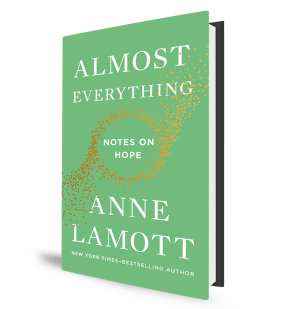
Anne Lamott is known for emptying her inner life and her struggles onto pages with words that resonate owing to their visible threads of connection, empathy, spiritualism, and witty innuendoes. With “Almost Everything”, she attempts a discourse on everything that she could possibly advise her niece on, to live in the age of Trump. While steering clear of the political landscape, shards of it and the disenchantment arising from it, is visible in the condensed pages of wisdom that Almost Everything embodies.
I have been familiar with Anne’s work through her classic tome on writing and on life called “Bird by Bird”. The precocious love for writing and for experiencing life through the process of writing seeps through her sentences in this acclaimed work and I have had to go back to it often to re-associate myself on this extraordinary passion for writing. Her passion, as evident in the stream of 18 books she has delivered, is contagious. So is her dedication to spirituality and to theism. She offers the rational mind a practical justification for believing in the supreme being and making do to tide over the feeling of hopelessness and depression.
“The medieval German mystic Meister Eckhart said that if the soul could have known God without the world, God never would have created the world.”
What she offers is a real compromise towards preparing oneself for this age of hate and aggression where we are” “doomed, stunned, exhausted, and over-caffeinated”.
“I am stockpiling antibiotics for the Apocalypse, even as I await the blossoming of paperwhites on the windowsill in the kitchen,”
Taking pages out of her own life, Anne is more of a chronicler of personal experiences and channeling them into her approach to life. Her essays embody her as a person and is a valuable portal to interact and engage with her thoughts.
“Help is the sunny side of control.”
Oddly, as I watch reruns of Frasier – the popular sitcom show of the 90s, I am often reminded of Anne’s attempts to help her friends and family and in failing to do, blaming herself for how it turned out to be. Frasier, with its own reliance on old-school values of ethics, integrity, sympathy, and honesty turns out to be a television equivalent of Anne’s books. In his vain attempts at being helpful to his brother, his father, or even random strangers he happens by Frasier’s well-intentioned attempts often end up counterproductive. And yet he labors on. Anne suggests an alternative, of stopping in your tracks and understanding if indeed the person needs your help or simply needs an ear to listen.
“Haters want us to hate them, because hate is incapacitating. When we hate, we can’t operate from our real selves, which is our strength.”
Her folksy, spiritual writing is inspirational and does imbibe a sense of optimism in our lives. Its more stoic than Christian from where I see it and that’s a good thing. Operating from our real selves is possibly the sanest, simplest, and practical advice one can get in this age of hate.
 Jargogled Impressions.
Leave a comment