Business models are like the electrical wires that connect the different appliances in a home. Without them none of the individual pieces of product, sales, finance, growth, business development would cohesively gel together. Usually, the business models are natural outgrowths that spin around the way of being for a business and form an invisible ring fence around an established business. It’s often hard to put down a model of sorts for any business because they are usually amorphous concepts. When it comes to white spaces though, considering your existing business model and the delta between what is and what’s required becomes crucial to the point of survival for an organization. Traditional business models across industries are periodically subjected to the tremors of new technology, new entrants, new social-political climate, and new customer set. Some of these factors are more troublesome than others and sensing their relative impacts become key differentiators for a sustainable business.
Think about it, per a Credit Suisse research, the average age of an S&P 500 company has gone down from 60 years in the 1950s to about 20 years today. The rampant disruption from new technologies and competition eventually kills off even the best of breed companies (unless you are Amazon and wrapped up 100 companies within itself). Amazon, in fact is adept at capturing the white spaces the moment it appears on their radar. White spaces are those un-chartered territories that a business often finds itself staring at. Many a times these white spaces appear tightly bounded like a gift for these businesses that they can grab with gleeful hands. Other times, these white spaces are garnished with spices or poisoned with curses that end up destroying the naïve capitalists. Separating what is from what can be therefore, becomes a useful exercise for the decision makers in these organizations.
My father had a pharmacy shop as his primary business concern. For him, knowing the payment cycle of his suppliers and his revenue velocity was a key component of how he managed his finances. Further, as a resident doctor held practice within his business premises, his core value proposition was defined and limited to the stocks that these Rx prescriptions typically demanded. As a sort of a platform between the patients and the doctor, his core profit model was to incentivize the sell-side entities to stay within his platform while ensuring that the delivery of products was met out in a fashion most conducive to the customer segments that formed part of his clientele. Giving thought to the overall business model as a written down construct would never have occurred to my father, as would have been the case with most ultra-small, small, and medium business owners. Even large-scale enterprises often end up muddying their overall business models to an extent that it becomes unrecognizable after some time.
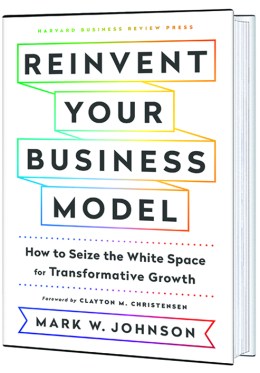
In the book “Reinvent your business model”, noted business writer and management consultant Mark Johnson sets out to revise his original thesis in “Seizing the While Space: Growth and Renewal Through Business Model Innovation” to provide a more contemporary understanding of what it means to rejig your existing business model and understand the forces of technology and the imperative of change through innovating on the core tenets of business models. I liked the precise and clear approach to thinking through:
- What a robust business model looks like and the key components?
- When do companies require a new business model?
- How do companies make business model innovation a continuous process?
In answering these questions, the author sets out to articulate the need and the approach to reinvent existing business models to ensure firms don’t lose out on capturing the untapped value baked into the “white spaces” they find themselves with every occasionally. For the pharmacy example, understanding the difference between tapping into the adjacency (increasing medical / nutritional product SKUs) versus capturing the white space (moving upstream to wholesaling medicines) would have meant completely different investments for my father. For organizations big and small, organizing your next move into what it takes to deliver is naturally a good exercise.
The four-box framework for understanding business model, as laid down by the author, is a useful tool to quickly map out the core tenets of the white space opportunity. Swimming along these four boxes in an iterative fashion can yield insights into what new models the business may need as it ventures boldly into the new frontier:
- customer value proposition: an offering that satisfies the “job-to-be-done” for the customer at a given price;
- profit formula: how the company creates value for itself and its shareholders (cost breakdown, revenue model, target unit margin, resource velocity)
- key processes: people, process, product, technology, equipment, etc.
- key resources: operational processes around design, development, sourcing, mfg., marketing, hiring
While patterns of business models inevitably surface as you consider the disruptive business models of today (freemium, bundling, dis-intermediation, platform, open source, etc.) I found the idea of articulating patterns via analogies particularly interesting. Stories are probably the best way by which you can disseminate new ideas and approaches within the entrenched interests within a firm. Analogies from other industries can help shape the conversations to a more real, on-ground concept. Think of “Uber for…”, or “Shopify for..”, or “Netflix of..”, or “Stripe for..” as you think about the kind of business model you will need to be able to capture the ‘white space’ you constantly stare at. Consider then, that a new business model may or may not be what your organization is capable of implementing. An informed decision, especially when it comes to consciously / unconsciously rejigging the core wires around your business, may be a better approach than to relinquishing the space altogether. And Mark Johnson’s book can help shape your approach.
 Jargogled Impressions.
Leave a comment